|
MISTAKE-PROOFING YOUR MEDICAL CARE
Excerpted from the first chapter of:The Savard Health Record: A Six-Step System for Managing Your Health Care by Marie Savard, M.D. (New York: Time Life Books, March 2000.)
If you did nothing except fill out and use your Health-at-a-Glance and Emergency Information Card, you would have dramatically reduced the margin of error in every aspect of your health-care. Of course, each of my steps is an important part of the Health Record system and I certainly don't want you to stop after Step 1. But I do want you to marvel with me about the fact that in a matter of minutes, just by writing down information pretty much off the top of your head, you will have created two little documents capable of saving your life. In an emergency, even if you were unconscious, doctors who have never laid eyes on you before would be able to proceed without worrying about drug interactions and allergic reactions. They would have very good clues to help them make an accurate diagnosis. And they wouldn't end up giving you shots or drugs you didn't need or that could be dangerous for you.
Your Health-at-a-Glance sheet can also help your doctor help you during the course of routine medical care. He will have a complete synopsis of your health status on a single page. Reading it will remind him -- or inform him for the first time -- of crucial details that could affect your outcome. Don, a 70-ish retired businessman, is a case in point. He went to a doctor in Florida for his first visit since moving there. Don was one of the people I had enlisted to help me test my Health Record, and he brought the binder with him to the appointment. On the Health-at-a-Glance sheet, he had listed Coumadin, a prescription blood thinner he was taking for atrial fibrillation, a common heart rhythm disturbance. He had also written down two over-the-counter herbal preparations: gingko biloba, which has a reputation as a memory enhancer, and saw palmetto, which has been reported to ease symptoms of benign prostatic hyperplasia (BPH). This condition affects some 40 percent of men over 70 and causes frequent, urgent or incomplete urination. As soon as Don's new doctor looked at the Health-at-a-Glance sheet, he spotted a couple of problems. First, gingko may inhibit clotting and shouldn't be taken with Coumadin. Second, saw palmetto can work so well to shrink the prostate -- and thus lower the results of a test for the enzyme PSA- that it may mask prostate cancer. The doctor advised Don to stop the gingko, and he asked Don to get copies of previous blood work so they could compare the results for PSA before and after Don started taking the saw palmetto. But, of course, since Don was already following my system, he had copies of his test results right there in his binder and didn't have to track them down.
The Savard Health Record has complete step-by-step instructions for filling out the Health-at-a-Glance form provided here.
View Health-at-a-glance form.
View Health-at-a-glance with sample patient information.
(In order to download these forms you will need Adobe's free Acrobat Reader.)
 |

Health-at-a-Glance
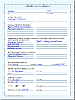
Health-at-a-Glance with patient information
If you cannot open the forms Download Adobe's free Acrobat Reader |